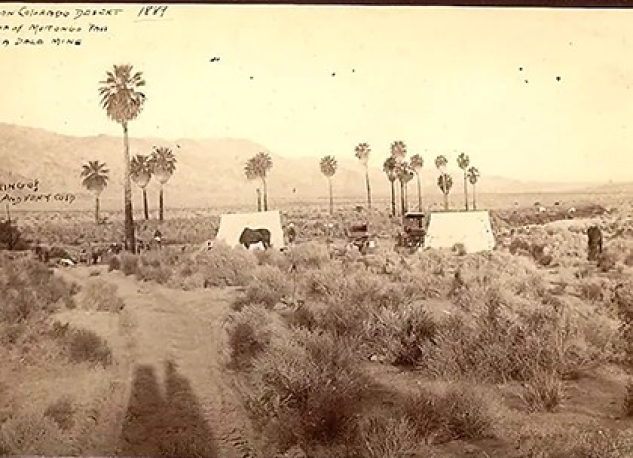
Early surveys in the 1850s noted native settlements at the Oasis that should have become reservation lands. However, in 1875, the state of California filed a claim on the entire Oasis, ignoring the natural rights of Chemehuevi and Serrano to their homelands. Shortly afterward, the state of California sold the Oasis of Mara to the Southern Pacific Railroad, all without the permission or knowledge of the Indian people. In this way, the state government and private company took possession of the land without consent from the two tribal lineages.
While in the late nineteenth century, the Chemehuevi still practiced traditional hunting, gathering, and cultivation techniques. However, as non-Indians moved into the area with their livestock, the native plant and animal resources that had nourished the Indian people for generations were depleted. Invading settlers also brought rifles, guns, dynamite, and gunpowder. Over time Chemehuevi had to supplement their economy by working for wages and buying processed foods. Still, they continued to practice their traditional way of life through seasonal rounds, but each year, resources declined due to non-Indian settlement. Each year, they traveled more to Indio and Banning to work on farms and ranches.
In 1890, Sister Catherine Drexel provided initial funding to build the Saint Boniface Indian School in Banning, California While working in Banning, some of the Mike children attended school at the Catholic boarding school, and as a result, some non-Indians gave them the name Boniface. The families of Jim and William Mike kept the Mike name, except Jeff Boniface, one of the children of Jim Mike who eventually married into the Soboba Band of Luiseño Indians where the family lives today. In 1909, Indian Agent Clara True and a small party visited the Chemehuevi and Serrano at the Oasis of Mara where a photographer took rare pictures of Maria and William Mike holding baby Dorothy Mike as well as Jim and Matilda Pine. During True’s trip to the Oasis, she surveyed a reservation for the Twenty-Nine Palms Tribal people on their homelands along the line of palm trees. When she attempted to file their claim for this reservation, the United States Land Office informed her that the state of California had claimed the land and sold it to the Southern Pacific Railroad. As a result, True could not file the claim, and no reservation could be established at the Chemehuevi and Serrano village at the Oasis of Mara.
In 1891, the Chemehuevi negotiated an agreement with the Mission Indian Commission (also known as the Smiley Commission) that led to an Executive Order in 1895 that created an Indian Reservation near the Oasis of Mara, located a mile south of the Oasis in the rocky foothills on land that had no water. The Chemehuevi and Serrano continued to live on the Oasis at their old village site. The reservation contained 160 acres of rock and sand, land that had no water and the no one ever farmed. The indigenous people of the Oasis of Mara came under the jurisdiction of the Mission Indian Agency, later changed to the Southern California Indian Agency. Superintendents did not like the Chemehuevi living so far out in the Mojave Desert, and some wanted to relocate them into the Coachella Valley. The Chemehuevi wanted to remain in the desert, as far from settlements as possible. For 10,000 years, Native Americans had hunted and gathered in the mystic desert landscape that became Joshua Tree National Park. The Chemehuevi, Serrano, and Cahuilla regularly used the high desert of majestic boulders, canyons, and caves as part of their seasonal rounds.